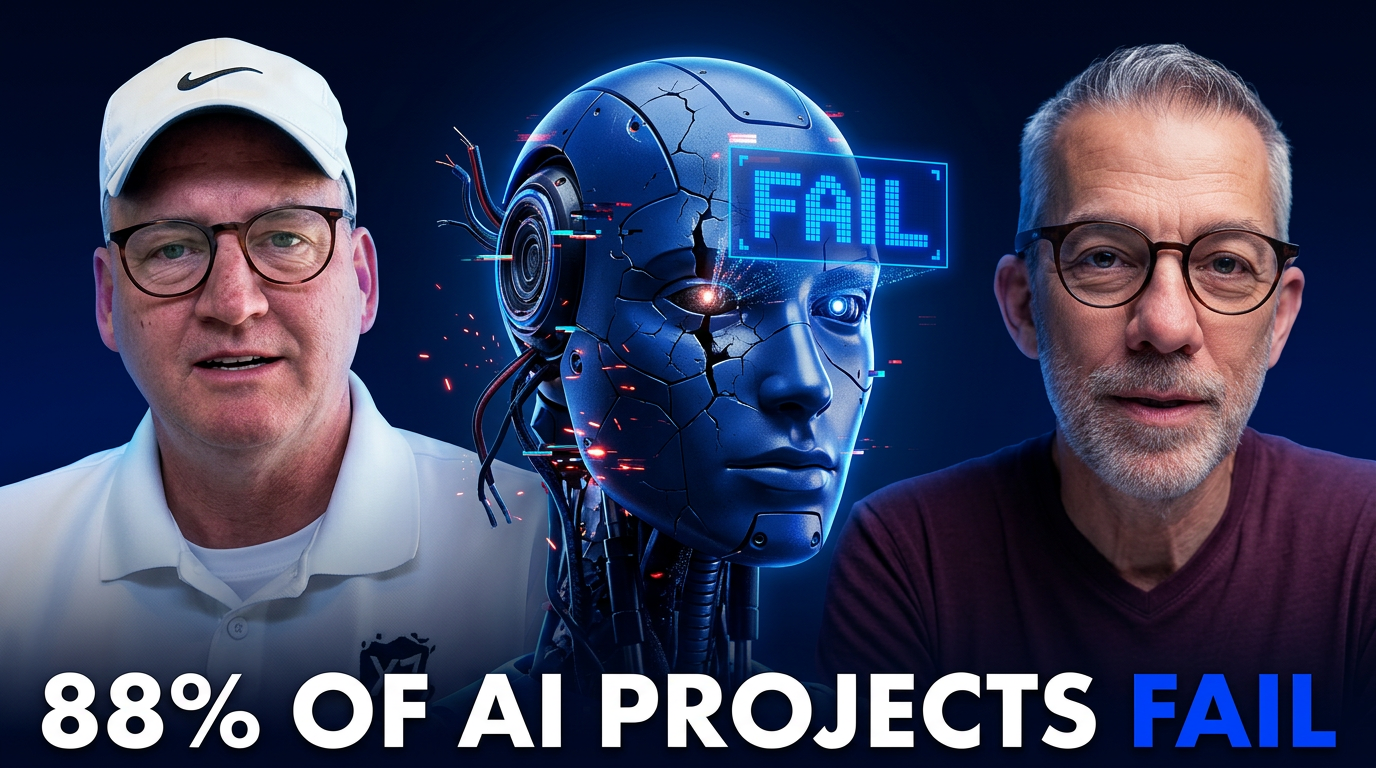
88% of AI Projects Fail. That’s Actually the Point
Here’s a stat that’ll make your brain hurt: 88% of AI projects fail to reach production.
Here’s another one: 92% of companies report positive ROI from their AI investments.
Both numbers are real. Both are from credible research. And if you’re staring at them wondering how in the hell those can both be true at the same time — good. That’s exactly the question Tom Brouillette and I dug into on this episode of Supply Chain Unlocked.
Tom’s a CIO Magazine contributor and has been deep in enterprise AI implementation for years. His take? The failure rate isn’t a warning label. It’s a feature. So let’s actually look at why AI projects fail — and why that answer might change how you budget your next initiative.
Why Most AI Projects Fail (And Why That’s Fine)
The 88% number refers to projects that never make it to full production. They get killed in pilot, or they stall after the proof of concept, or they get defunded before they scale.
That sounds bad. It’s not.
Most of those projects taught the organization something. They exposed bad data. They revealed a process problem that had nothing to do with AI. They proved the vendor’s solution didn’t fit the actual workflow. That’s not failure — that’s R&D doing exactly what it’s supposed to do.
The companies reporting 92% positive ROI? They ran those same “failures.” They just didn’t call them failures. They called them experiments.
Proof of Concept vs. Proof of Value — Know the Difference
This is where Tom dropped the most useful framework of the whole conversation:
Proof of Concept (POC): Can this technology work? Binary. Yes or no. Too often treated as the finish line.
Proof of Value (POV): Does this technology actually deliver something worth paying for in our environment, with our data, in our workflow? This is the only question that matters for business.
Tom’s advice: don’t calculate ROI during the POC phase. Budget it from R&D or innovation funds. Give it room to breathe. If you’re measuring financial return on a proof of concept, you’re asking the wrong question too early — and you’ll kill good ideas before they have a chance to prove themselves. Most AI projects fail precisely because teams measure the wrong thing at the wrong stage.
Build vs. Buy: Tom’s 3 Rules for AI ROI
Tom laid out a clean framework for deciding when to build custom AI and when to buy off-the-shelf:
- If a vendor can prove value in your environment before you pay — buy it. Companies like PagerDuty have successfully negotiated contracts where payment kicks in only after the vendor demonstrates results. Push for that structure.
- If the problem is truly unique to your operations — build it. But be honest about whether it’s actually unique or whether you’re just attached to doing things your way.
- If you can’t clearly define the problem you’re solving — do neither. Stop. Define the problem first. AI won’t save a process you don’t understand.
The Metric Nobody’s Talking About
Here’s the one that stuck with me. IBM surveyed CEOs and found that 65% said customer trust is more important to their long-term success than specific product features.
Not revenue. Not technology. Trust.
The AI projects that win aren’t just the ones that work technically. They’re the ones that make the people touching them — customers, employees, partners — feel like the system is working for them, not around them.
Build for trust. The ROI follows.
Want to go deeper on why AI projects fail? Our next episode breaks down the accountability gap that quietly kills most enterprise initiatives — Nobody Owns Your AI Project.
Watch the Full Episode
Tom and I go deep on all of this — including some war stories about enterprise implementations gone sideways and what actually turned them around.
Supply Chain Unlocked is a show about the real decisions, real failures, and real results behind enterprise operations and technology. No fluff. No sponsored content. Just the work.